
First, the conclusion: the way to read a baccarat hand example is to first check whether the first two cards are a natural 8 or 9, then see whether the Player needs to draw a third card, and finally determine whether the Banker draws based on the Banker third-card rule; the side with the higher final total wins, and if both totals are the same, it’s a tie. Once you grasp this flow, you can understand almost every round quickly.
If you want to compare against real hand examples directly, go to the winlok official website for the full breakdown first, then come back and compare it with the steps below. It’ll be much easier to get the hang of.
What to look at first in a baccarat hand example: card values, naturals, and draw order
Baccarat only compares the point totals of the “Player” and “Banker” hands, and only the ones digit counts. Aces count as 1 point, 2 through 9 count at face value, and 10, J, Q, and K all count as 0. In other words, if the total of two cards is over 9, only the ones digit counts; the tens digit is ignored.
For example, 7 plus 8 is 15 points, but baccarat counts it as 5 points; A plus 9 is 10 points, which counts as 0. This conversion method is the first step to understanding baccarat hand examples.
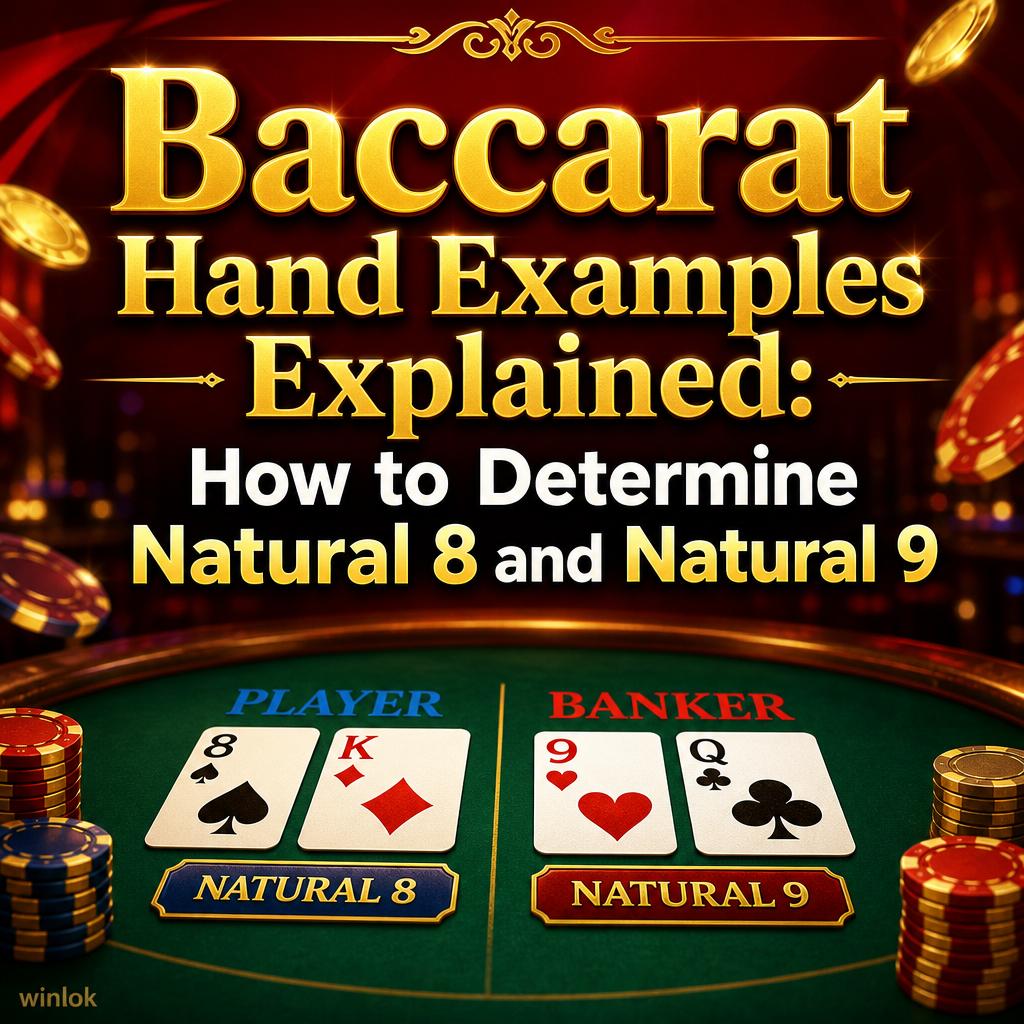
How to tell a natural 8 from a natural 9
At the start of each round, two cards are dealt to each side. If either side’s first two cards total 8 or 9, that’s called a natural. In that case, the hand usually stands immediately and no third card is drawn; then the two sides are compared directly.
The part that most often confuses beginners about naturals is thinking both sides still draw as usual. That’s not the case. Once a natural 8 or 9 appears, the round usually moves straight to comparing hands, and the normal drawing process no longer applies.
- First two cards total 8 points: natural 8
- First two cards total 9 points: natural 9
- Natural appears: usually stand and compare hands immediately
Player draw or stand: the easiest rule to remember first
If there is no natural, look at the Player first. In general, if the Player’s total is 0 to 5, a third card is drawn; if it’s 6 to 7, the Player stands. This is the easiest step to judge in a baccarat hand example because the Player’s rule is relatively fixed.
For example, if the Player’s first two cards are 2 and 3, totaling 5, the Player usually draws; if they are 4 and 3, totaling 7, the Player stands. Once you calculate the Player’s total correctly, you can then apply the Banker’s rule.
Real hand example: when the Player draws first
Suppose the Player’s first two cards are 2 and 3, totaling 5, and the Banker’s first two cards are 4 and 2, totaling 6. Since there is no natural, you look at the Player first. The Player’s 5 means a draw is required, and after the third card is dealt, the Banker’s draw decision is made according to the rule.
This is also where many people get stuck the first time they read a hand example: you don’t check whether the Banker draws first. You check whether the Player draws first. If you get the order wrong, it’s easy to read the whole round incorrectly.
Banker third-card rule: the most confusing part
Whether the Banker draws is not determined by the Banker’s own total alone; it also depends on the Player’s third-card value. This is the part of baccarat hand examples that most often confuses beginners, because the Banker is not simply “draw when low, stand when high.”
You can think of it as a two-step decision: first look at the Banker’s current total, then look at the Player’s third-card value. Only when you combine both do you know whether the Banker draws.
- First confirm whether there is a natural.
- If there is no natural, determine whether the Player draws.
- If the Player draws a third card, use the Banker’s total and the Player’s third-card value to decide whether the Banker draws.
- Once both sides are done, compare the final totals.
For example, if the Banker’s first two cards total 6, then depending on the Player’s third-card value, the Banker may stand; in another case, the Banker may draw. When reading actual hand examples, don’t just focus on the Banker’s first two cards—the Player’s third card is the key variable.
How to read the winner and a tie: only the final total matters
The result in baccarat is straightforward: after drawing is complete, whichever side has the higher final total wins; if both sides have the same total, it’s a tie. When the totals are the same, it doesn’t matter who drew first or who drew a card first—it’s simply a push.
For example, if the Player ends with 7 and the Banker ends with 6, the Player wins; if the Player ends with 5 and the Banker also ends with 5, it’s a tie. When reading a hand example, calculating the final totals first and then drawing a conclusion is more accurate than looking only at the cards in the middle of the round.
How to read a tie hand example
A tie most often happens when both sides end up with the same total after drawing, or when both sides have the same natural 8 or 9. In that case, there’s no need to look for which hand “looks better,” because baccarat only cares about point totals, not suits, straights, or pairs.
If you see a round where both sides end with 7, that’s a tie; if one side has 8 and the other has 7, then the side with 8 wins. Don’t be misled by the face value of the cards—the key is always the ones-digit total.
Quickly compare with a few baccarat hand examples
Below are a few common situations that tie together baccarat card values, drawing, standing, and the result so you can better understand the full flow.
- Player A + 4 = 5 points, so the Player usually draws; Banker has 7 points and may stand depending on the Banker rule; then compare final totals.
- Player 3 + 4 = 7 points, so the Player usually stands; Banker has 5 points and may draw depending on the rule; then see which side has the higher total.
- Player 4 + 5 = 9 points, a natural 9, so the Player usually stands immediately; if the Banker also has a natural, compare totals directly.
- Player 10 + 6 = 6 points, which is still treated as 6; it is not 16.
- Player 2 + 3 = 5 points and draws, then the Banker decides whether to draw based on the Player’s third card; this is the most typical decision flow.
You’ll notice that what really matters is not memorizing a bunch of scattered exceptions, but following a fixed order: calculate the totals, check for naturals, see whether the Player draws, and only then apply the Banker third-card rule. As long as the order stays clear, the hand example is not hard to read.
Three things beginners most often misread
The first mistake is counting 10, J, Q, and K as 10 points. That’s not how baccarat works—those cards all count as 0. The second mistake is trying to decide whether the Banker draws before the first two cards on both sides are even resolved. The third mistake is forgetting that a tie is also a result, not just “no winner.”
If this is your first time reading hand examples, it’s best to focus on just three things: calculate the totals, look for a natural, and check whether the Player draws. Once those three steps feel familiar, add the Banker third-card rule, and you’ll get much faster.
If you want more organized explanations, you can go directly to the winlok official website for similar guides; if you’re brand new, you can also start by practicing with the simplest cases: naturals and ties.
FAQ
What’s the difference between a natural 8 and a natural 9 in baccarat?
The only difference is the total; the logic is the same. As long as the first two cards total 8 or 9, it’s usually treated as a natural and the hand goes straight to comparing totals without the normal drawing process.
What’s the easiest way to remember the Player draw rule in baccarat?
Just remember: 0 to 5 draws, 6 to 7 stands. As long as you calculate the Player’s total correctly first, you can then apply the Banker’s rule.
How should I read a baccarat tie?
If both sides end with the same total, it’s a tie, whether that happens after drawing or after a natural. The decision is the same either way.
If you want to read baccarat hand examples faster, the next step is to take a real round and practice in this order: “calculate the totals first, then check for a natural, then check the Player, and finally check the Banker.” That way, you can figure out the result yourself in almost every round.