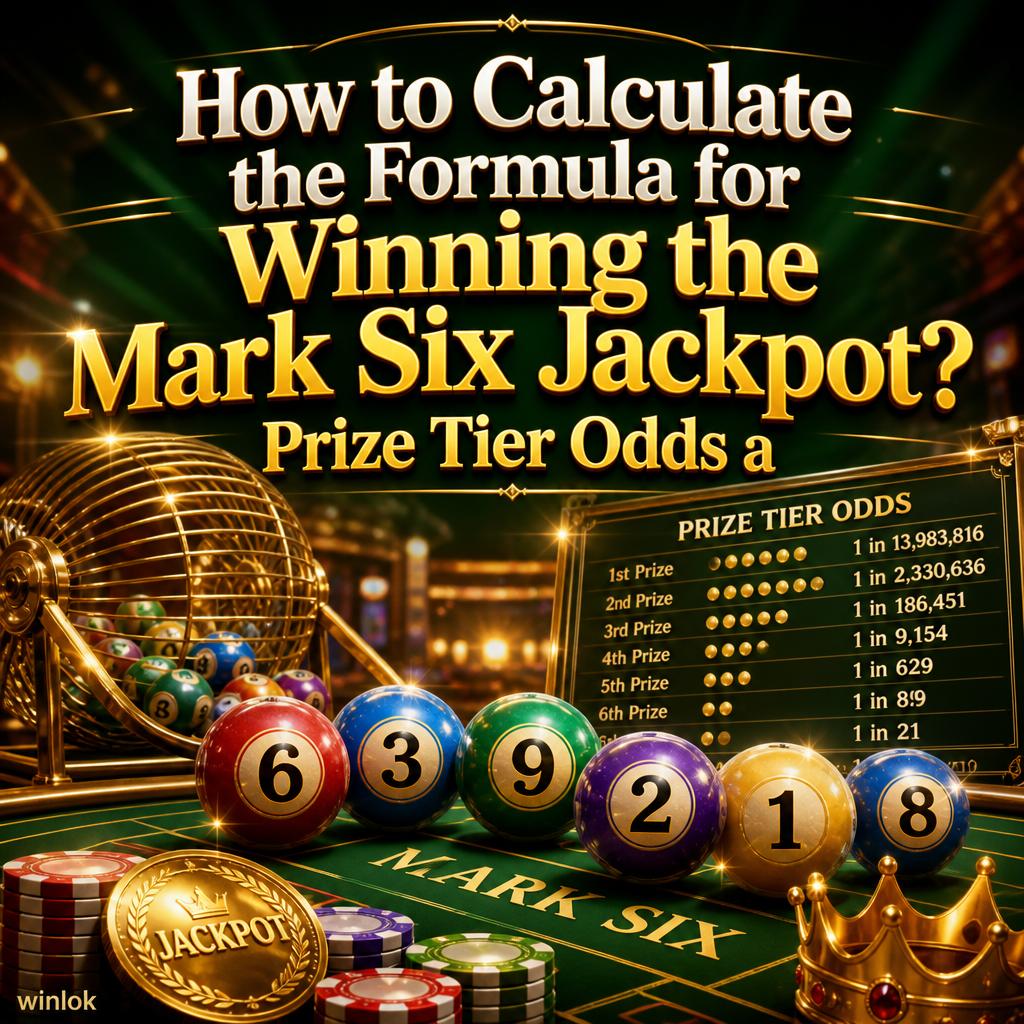
The probability of winning the Mark Six jackpot can be calculated directly with combinatorics: if you choose 6 numbers from 49, and the draw also picks 6 numbers, then the jackpot odds are 1 / C(49,6), which is about 1 / 13,983,816, or roughly 0.00000715% in percentage terms. If you want to understand the second prize and other prize tiers, the key is to first calculate the total number of combinations, then see how many main numbers each prize tier requires and whether the special number also has to match.
How to calculate the Mark Six jackpot odds
First, break the problem down: one ticket means choosing 6 numbers out of 49; at the draw, 6 main numbers are also drawn from the same set of 49 numbers. Since every 6-number combination is equally likely, the total number of combinations is “49 choose 6.”
The combination formula is:
C(n, r) = n! / [r! × (n-r)!]
Plugging in the numbers gives:
C(49, 6) = 49! / (6! × 43!) = 13,983,816
So the jackpot odds are:
1 / 13,983,816 ≈ 0.0000000715
As a percentage, that’s about 0.00000715%. In other words, on average, you’d need to try a huge number of times before hitting the jackpot once; it’s not about how “fast” it is, but about how large the combination space is.
How to understand the total number of combinations and the formula
Many people instinctively think, “There are 49 numbers, and each number has a chance,” but what really affects the jackpot is the full 6-number combination. You’re not guessing a single number; you’re guessing a complete set of 6 numbers.
For example, 1, 2, 3, 4, 5, 6 and 6, 5, 4, 3, 2, 1 are actually the same combination and do not count as 720 different outcomes. That’s why combinations are used instead of permutations.
You can think of it this way: all possible 6-number combinations are laid out, and every one of them has the same chance of being drawn. If the set you bought exactly matches the 6 drawn numbers, you win the jackpot.
How do the odds differ for the second prize and other prize tiers
Mark Six doesn’t just have “all match” and “no match” outcomes; it also depends on how many main numbers you matched and whether the special number is included. Because the conditions are looser, the odds are much better than the jackpot, but they’re still low-probability events.
| Prize tier | Common rule | Odds concept |
|---|---|---|
| Jackpot | Match all 6 main numbers | 1 / 13,983,816, the lowest |
| Second prize | Match 5 main numbers plus the special number | Higher than the jackpot, but still very low |
| Other prize tiers | Depends on matching 5, 4, or 3 main numbers, or combining with the special number | The fewer numbers you need to match and the looser the conditions, the higher the odds |
From a purely mathematical perspective, the second prize is easier to win than the jackpot because it allows you to miss one main number as long as the special number matches too. The other prize tiers are even looser than the second prize, so their winning rates are usually higher. But “higher” does not mean “easy,” because compared with the total number of combinations, these events still happen very rarely.
If you want to make a practical judgment, the most important thing is to distinguish between the jackpot, where all numbers must match, and the other prize tiers, where only part of the numbers need to match. The odds are vastly different, so they should not be lumped together.
Mark Six odds table
Here’s the clearest way to compare the difficulty of each prize tier:
| Comparison item | Condition | Relative difficulty |
|---|---|---|
| Jackpot | Match all 6 main numbers | Highest |
| Second prize | 5 main numbers + special number | Very high, but lower than the jackpot |
| Other prize tiers | Match fewer main numbers, or combine with the special number | Varies by condition, usually easier |
What this table really shows is not “which prize is bigger,” but “the stricter the conditions, the lower the odds; the looser the conditions, the higher the odds.” This principle applies to almost all similar lottery games.
Do hot numbers, cold numbers, and historical data matter?
The answer is straightforward: they do not affect the odds of the next draw. Each draw is an independent event. What happened in the previous draw does not change the combination space for the next one, and it does not make any number suddenly more or less likely to appear.
So hot numbers, cold numbers, consecutive numbers, and numbers that haven’t appeared for a long time can at most be used for statistical observation; they cannot be used as a basis for prediction. You can treat them as “trend data,” but not as a way to improve your odds.
This is where many people misjudge things: when they see a number that hasn’t come up for a long time, they think it is “due”; or when they see a number appearing often, they think it is “hot.” In reality, random draws do not remember the past, and each draw starts fresh.
If you want to judge this more clearly, the most practical approach is to accept one premise first: probability is determined by the rules, not by feelings. What you can do is understand the rules, read the prize tiers, and know the risks—not use past results to predict the next draw.
How to judge the Mark Six jackpot odds in practice
- First confirm that the game is to choose 6 numbers from 49.
- Define the jackpot as matching all 6 main numbers.
- Use C(49,6) to calculate the total number of combinations.
- Divide 1 by the total number of combinations to get the jackpot odds.
- Then look at the conditions for the second prize and other prize tiers to understand why they are easier to win than the jackpot.
- Finally, put hot numbers and historical records back in the category of statistical observation, and don’t treat them as prediction tools.
If you just want the quick takeaway: the Mark Six jackpot odds are extremely low, the second prize odds are a bit better but still very low, and the other prize tiers are easier to win because the conditions are looser. What really changes is not the odds themselves, but how well you understand the rules.
For more organized information, you can visit the winlok official website; if you also want to compare other lottery information, the winlok official website is easier to browse. If you run into any request to pay a handling fee or deposit first, stay alert, and if you have doubts, call 165.