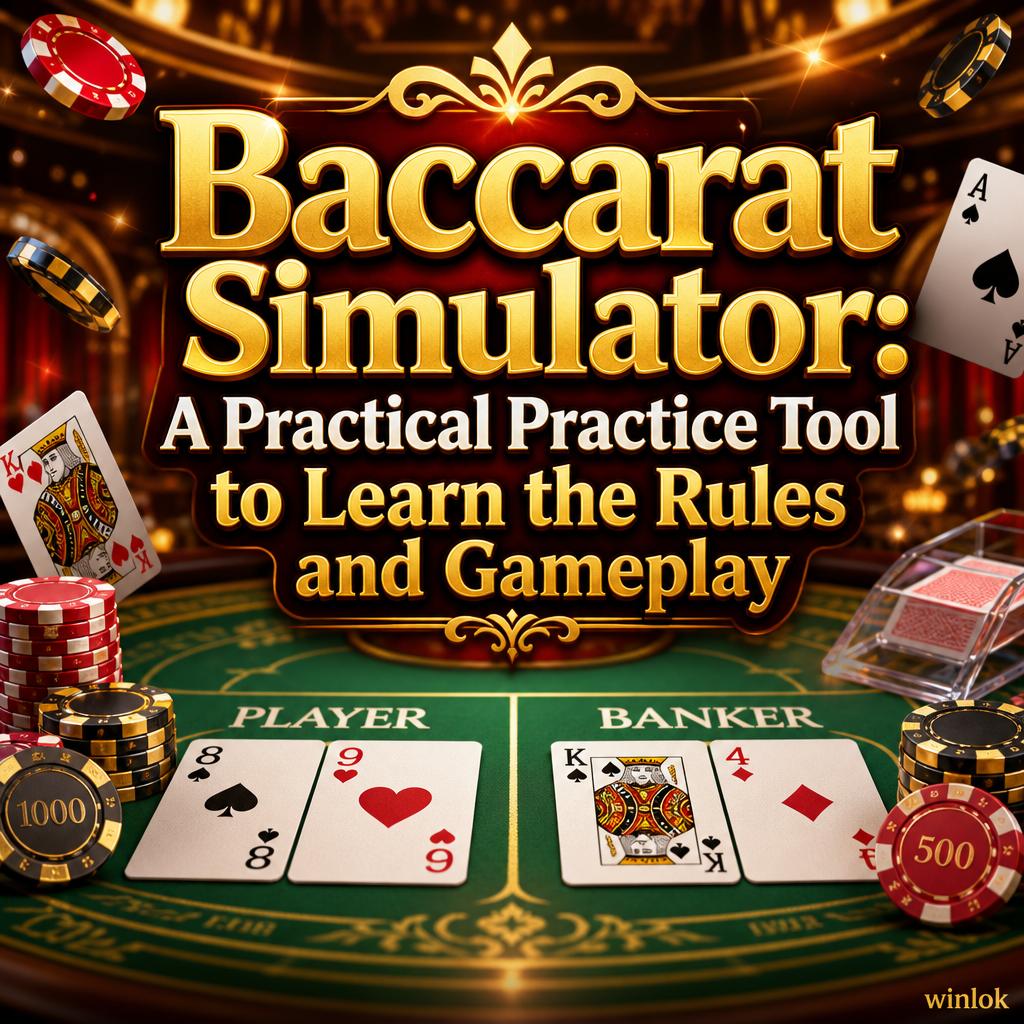
Baccarat simulators are best used first to get familiar with the rules, practice the betting flow, and test different stake sizes while observing long-term fluctuations. But they only reflect the calculated results under the given settings, so they cannot predict a real game, and they definitely cannot guarantee that you will win in actual play. Treat it as a practice tool first, then decide whether to use it further.
You can start by checking the information on the winlok official website, then choose the most suitable simulation method based on your needs. If you just want to understand how the game works, starting with the most basic game simulation is enough.
What is a baccarat simulator, and how to tell whether it’s worth practicing with
At its core, a baccarat simulator recreates baccarat rounds through a program or rules-based model, letting you see how Banker, Player, and Tie outcomes appear without putting in real money. For beginners, its most practical value is not “guessing the next hand,” but understanding the betting order, game pace, and payout differences first.
If you’re still unfamiliar with the game flow, a simulator can help you practice how to bet each round, when settlement happens, and what Banker, Player, and Tie each mean, so you won’t feel flustered when you actually start. This step matters because many people don’t lose because they misunderstand the rules, but because they start with the wrong way of judging the game.
Its most common uses: learning the rules, practicing bets, and testing strategies
The most direct use of a baccarat simulator is to help you get familiar with the rules first. You can repeatedly review the differences between Banker, Player, and Tie, and also understand how settlement works after placing a bet, so you won’t only realize you’re unclear on the process once you start playing for real.
The second use is practicing betting and timing your decisions. In a simulated environment, you can observe streaks of Banker wins, Player wins, or alternating patterns, and see how you would decide in different situations. The value of this practice is not in finding a “sure-win method,” but in learning when you tend to chase losses, hesitate, or get influenced by short-term results.
The third use is testing different stake strategies. For example, fixed stakes, progressive betting, or adjusting the amount after wins and losses can all be run in the simulator for a period of time to observe how the bankroll curve changes. You’ll get a clearer sense of whether a certain betting method causes your bankroll to drop too quickly during losing streaks, and whether it really amplifies gains during winning streaks.
Watching long-term fluctuations matters more than focusing on a single round
If you only look at one or two rounds, a baccarat simulator can easily make it seem like a certain trend is forming. But over a larger number of rounds, you’ll be more likely to see how probability fluctuates. Winning streaks, losing streaks, Banker/Player distribution, and Tie frequency all become more apparent as the number of rounds increases, helping you understand that baccarat is not a game you can reliably master through a single decision.
That’s another value of a simulator: it makes risk more concrete. When you see your bankroll curve moving up and down, it becomes easier to understand why even when things seem to be going well for a while, long-term volatility can still give back your gains. For anyone trying to build basic judgment, this is more helpful than simply memorizing a few betting slogans.
Simulation results can be referenced, but they cannot be taken as direct real-world answers
One thing needs to be clear: the results produced by a simulator only reflect the rules, probability settings, or calculation conditions it uses. They do not mean that a real game will definitely develop in the same way in the future. Real situations are affected by actual dealing, game rule details, changes in the number of rounds, and other unpredictable factors, so simulation results cannot be treated as a guarantee.
Because of that, a baccarat simulator can help you practice, but it cannot guarantee profits. If you treat it as a tool that says “follow this and you’ll definitely win,” you may end up overestimating your own judgment. A more reasonable approach is to use it as a tool for understanding risk, checking betting habits, and comparing the differences between methods.
When using it in practice, here’s how to decide what to look at
- First confirm whether you want to practice the rules or test stake sizes.
- If your goal is to get familiar with the flow, start by looking at how Banker, Player, and Tie are settled.
- If your goal is to test betting methods, keep the conditions fixed and run more rounds.
- If your goal is to assess risk, focus on the bankroll curve and drawdowns during losing streaks.
- If you just want to get a feel for it, don’t treat short-term results as a conclusion.
You can also visit the winlok official website first to read the organized explanation, then decide which method to use for practice. If you’re just getting started, understanding the rules and flow is more important than rushing to find betting answers.
Frequently asked questions
Is a baccarat simulator suitable for beginners?
Yes. Beginners most need to understand the rules, betting flow, and the differences between Banker, Player, and Tie first, and a simulator provides exactly the kind of environment where they can practice repeatedly.
Can it be used to test different stake sizes?
Yes, but treat it as a comparison tool, not a prediction tool. You can see how different stake sizes affect your bankroll during winning and losing streaks, but you cannot infer that a real game will necessarily produce the same results.
Can simulation results represent actual baccarat games?
Not directly. They only reflect the results under simulated conditions, and real games may still differ depending on how they actually unfold.
If you’re ready for the next step, it’s recommended that you first use the simulator to understand the rules, betting flow, and bankroll changes before deciding whether to invest further. If you encounter any suspicious request for an upfront processing fee or deposit, stop first, and if necessary, you can call 165 to check.