Let’s start with the conclusion: baccarat card counting is not a guaranteed-profit tool. At best, under certain shoe structures, it can give you a slight estimate of the Banker and Player win rates; what truly affects long-term results is still the payout design, commission, and volatility. If you want to understand it, first grasp the probabilities and house edge, then decide whether to treat it as a reference—not as a sure-win method.
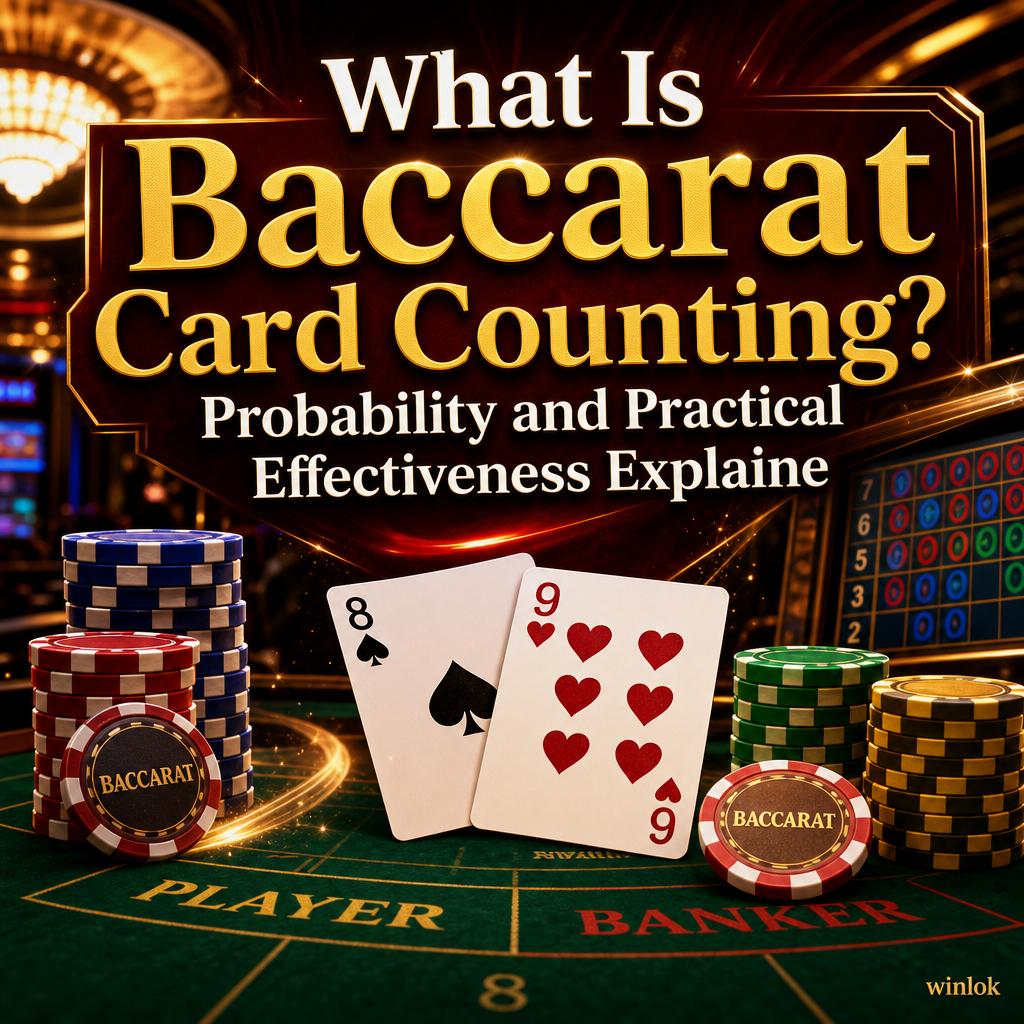
The core of baccarat is not “guessing the next hand,” but understanding the theoretical return differences of each bet. If you only remember one thing, it should be this: Banker bets usually have a relatively better long-term expected value because of the payout structure and commission arrangement; Player bets come next; Tie bets, while offering high payouts, occur less often and are usually not suitable as a main strategy. That’s also why when people talk about baccarat card counting, it often sounds like it can turn the tables, but in reality it’s very hard to consistently offset the game’s built-in disadvantage.
If you want a more complete breakdown of the rules first, you can visit the winlok official website; if you want to directly compare the risk and return of different bets, the judgment below will be more practical.
How to read baccarat probabilities: look at win rate first, then payout
In each baccarat round, the result seems to be one of three choices: Banker, Player, or Tie. But what really matters is not “which one comes up most often,” but “which one is more favorable after payouts.” Betting is not just about hit rate—you also have to factor in the payout. In other words, a higher win rate does not necessarily mean a bet is worth making, and a lower win rate does not automatically mean it should be avoided. The key is the long-term average return.
Under standard rules, the theoretical win rates for Banker and Player are very close, with Banker usually slightly higher. However, Banker bets are reduced by commission, so the actual result is not simply “higher win rate means best choice.” Player bets don’t have commission pressure, but their theoretical win rate is slightly lower. Neither option turns into a player-favorable bet in the long run; Banker is just usually the one with the lower house edge.
Tie bets follow a different logic. The payout looks high, which makes people think that hitting it once can make up for many rounds, but the problem is that it occurs relatively rarely. Over time, it’s hard to offset the overall expected value with a single high payout. That’s why many people view Tie as a high-volatility option rather than a stable core bet.
What’s the difference between the theoretical win rates of Banker, Player, and Tie?
From a mathematical standpoint, the gap between Banker and Player is not large, which is one of the places where baccarat differs from many people’s intuition. Players often think “just a little difference” doesn’t matter, but in gambling, that small difference gets repeated many times and eventually becomes a noticeable expected-value gap. Banker bets are often seen as relatively advantageous because, when combined with the win rate and payout structure, the long-term loss is usually smaller.
Although Player bets don’t have commission, their theoretical return is still affected by the win rate. In other words, no commission does not mean the math disadvantage disappears. And Tie bets are even more straightforward: despite the attractive single-round payout, they don’t win by being frequent; they rely on a few high payouts to carry the overall result. If the frequency isn’t high enough, the long-term outcome is usually still unfavorable.
House edge and commission are what really determine long-term results
When many people study baccarat, they focus on the trend of the cards and overlook the fact that the house edge is what truly determines long-term results. You can think of the house edge like this: under fixed rules, the game design itself gives the platform a slight advantage in the long run. This advantage doesn’t need to win every round; it only needs enough rounds to accumulate before it becomes visible.
Commission works by pushing the apparent return of Banker bets down a bit further. That’s why Banker bets are often considered the option with the lowest disadvantage in baccarat, but they still are not positive expected value. You can think of it as “less unfavorable,” not “profitable in reverse.”
The most common misunderstanding here is treating short-term winning streaks as mathematical advantage. In reality, short-term results are magnified by volatility, and a few consecutive wins may look like a trend without meaning the underlying statistics have changed. If you judge that you’ve found a pattern based on just a few rounds, it’s easy to mistake random fluctuation for a repeatable edge.
What baccarat card counting is actually counting
So-called baccarat card counting usually isn’t like blackjack, where you track high and low cards and directly turn the game in the player’s favor. It’s more like looking at the cards already dealt and estimating the subtle effect of the remaining deck on Banker and Player win rates. In theory, changes in the composition of certain shoe patterns can cause slight shifts in one side’s win rate, but those shifts are usually very small.
The problem is that baccarat gives players very limited decision-making space. Most of the time, all you can do is choose Banker, Player, or Tie. There’s almost nothing like blackjack’s hit, stand, split, or double options that lets you actively amplify an edge. In other words, even if you understand how the deck changes, the room to use that information is still very narrow.
So baccarat card counting is more like “informational reference” than “profit guarantee.” It may help you judge whether certain situations slightly favor one side, but that edge is usually not enough to consistently overcome the house edge, commission, and game volatility. If you treat it as a simple, repeatable way to make guaranteed money, your judgment will be overly optimistic.
How is baccarat card counting different from blackjack card counting?
The biggest difference is whether the player can turn information into a clear decision advantage. In blackjack, changes in the proportion of high cards directly affect the expected value for both the player and the dealer, and players have many actions that can be adjusted based on the shoe, so card counting can potentially create a real edge.
Baccarat is different. Its rules are fixed, and players have almost no adjustable game actions. Even if card counting reveals some distribution shifts, it’s hard to turn those shifts into stable profit. On top of that, baccarat’s built-in edge gap is already small, so any tiny informational advantage is easily eaten up by commission and volatility.
So if you directly apply blackjack card-counting logic to baccarat, you’ll usually overestimate the effect. That’s why many people feel like they “understand the shoe,” but the actual results still don’t improve much.
What shoe statistics can and cannot tell you
Many people use shoe statistics as a basis for judgment, such as reading the Big Road, Bead Plate, or other trend records, trying to find patterns like Banker streaks, Player streaks, or alternation. These observations can help you organize historical results, but they do not change the independence of the next round. In other words, shoe records can be used as a logging tool, but they are not suitable as a direct prediction guarantee.
If you treat shoe patterns as trend signals, at most they can remind you whether the current game has entered a longer volatility stretch. But that doesn’t mean the next round will continue in the same direction, and it certainly doesn’t mean you’ve found a repeatable card-counting edge. What still matters is probability, payout, and risk tolerance.
Therefore, shoe statistics are better suited for post-game review than for claiming that you’ve found a sure-win pattern. Once someone presents trend charts as a stable profit basis, you should be cautious, because that usually goes beyond what the math can support.
How to judge whether baccarat card counting is worth paying attention to
- First, check which rules you’re discussing, because whether there is commission and whether there are special payouts will directly affect expected value.
- Then see whether you can actually turn the information into a decision advantage; if you can only read the cards but not change your actions, the effect is usually limited.
- Finally, consider whether you can accept volatility. Even if some situations offer a slight informational edge, that doesn’t mean you’ll definitely win in the short term.
If your goal is to understand the math of the game, then studying baccarat card counting has value. If your goal is to find a guaranteed-profit method, then you should not treat it as the answer. These two things should not be mixed together, or it’s easy to mistake “there may be a slight informational edge” for “it can generate long-term profit.”
Direct answer: can baccarat card counting guarantee profit?
The conclusion is clear: baccarat card counting should not be viewed as a guaranteed-profit tool. At most, it provides limited informational reference, but it’s very hard to consistently offset the house edge, commission, and random volatility. If someone packages it as a method that guarantees returns, that claim itself does not fit baccarat’s mathematical structure.
The more reasonable approach is to treat it as an auxiliary perspective for understanding the game, not as a betting guarantee. You can study probabilities, understand the differences between Banker, Player, and Tie, and learn how commission affects returns—but don’t equate “understanding it” with “making money.”
If you want to keep reading more casino information, it’s recommended that you go directly to the winlok official website; if you’ve already been asked to pay a processing fee or deposit first, stop there and call 165 to verify further.